
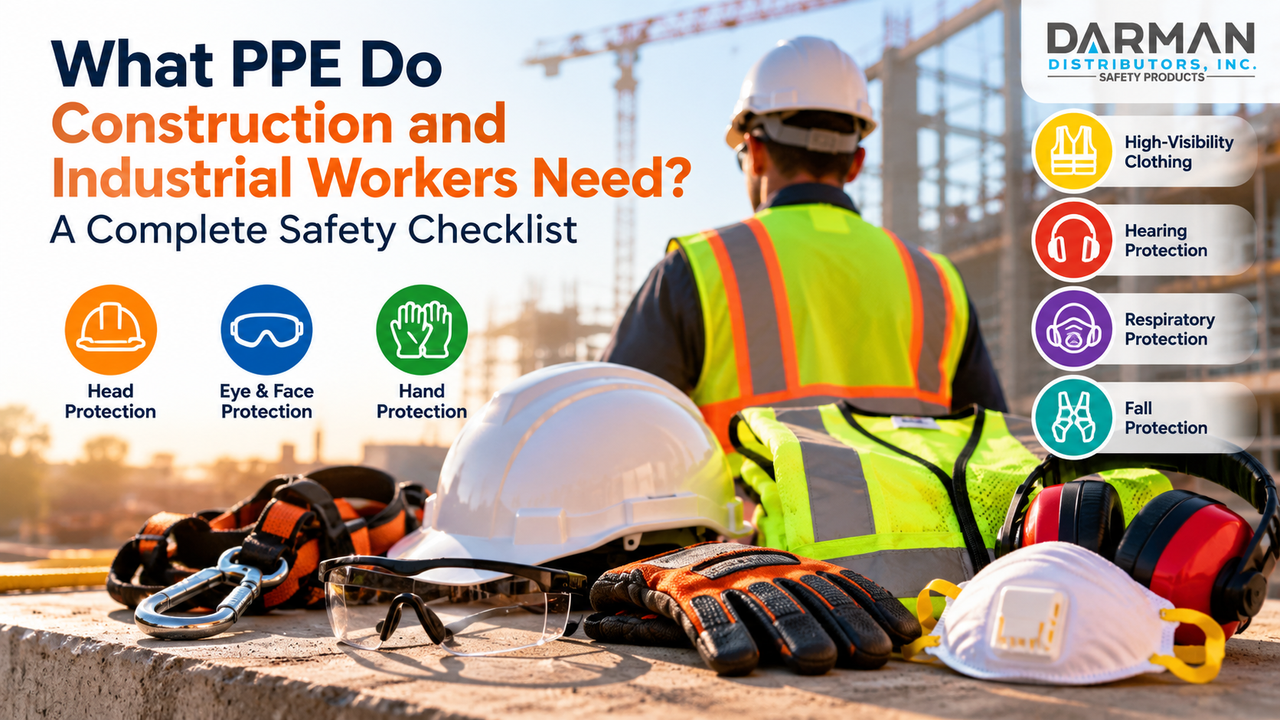
What PPE Do Construction and Industrial Workers Need? A Complete Safety Checklist
Oct 23rd 2026
Construction sites, warehouses, manufacturing facilities, and industrial workplaces expose employees to different hazards every day. From flying particles and sharp materials to excessive noise, falling objects, and moving vehicles, each work environment requires appropriate personal protective equipment (PPE).
The right PPE depends on the hazards workers face, the tasks they perform, and the safety requirements applicable to their workplace. A well-planned PPE checklist helps employers select suitable equipment, maintain consistent safety practices, and ensure employees understand how to use their protective gear.
Darman Distributors supplies workplace safety equipment, including safety gloves, protective eyewear, hard hats, hearing protection, fall protection equipment, and high-visibility apparel. This guide explains how to choose the essential PPE categories for construction and industrial work.
What PPE Do Construction Workers Need?
Construction workers may need hard hats, safety glasses, protective gloves, high-visibility clothing, safety footwear, hearing protection, respiratory protection, and fall protection equipment. The exact combination depends on the job, identified hazards, and applicable safety standards.
Before selecting equipment, employers should conduct a workplace hazard assessment. This process helps determine which protective measures are necessary and whether PPE must be combined with engineering controls, administrative controls, or other safety measures.
1. Head Protection: Hard Hats and Safety Helmets
Hard hats help protect workers from specific head injuries associated with falling objects, impacts, and other workplace hazards. The appropriate type depends on the risk assessment and the helmet's protective capabilities.
When selecting head protection, consider:
-
The type of impact or hazard workers may encounter.
-
Helmet type and applicable ANSI/ISEA requirements.
-
Proper fit, suspension condition, and compatibility with other PPE.
-
Whether accessories such as hearing protection or face shields are required.
-
Manufacturer instructions for inspection, storage, and replacement.
Workers should inspect helmets before use and remove damaged equipment from service. A helmet should also be replaced according to the manufacturer's instructions and after an impact when required.
Explore Darman's head protection equipment to find suitable workplace options.
2. Eye and Face Protection: Safety Glasses and Goggles
What type of safety glasses should industrial workers use? The answer depends on the exposure involved, including flying particles, dust, chemical splashes, or radiation from particular work processes.
Safety glasses may be appropriate for certain impact hazards, while goggles or face shields may be needed for additional protection. A face shield generally should not replace primary eye protection when safety glasses or goggles are required.
When choosing eye protection, evaluate:
-
Impact and particle hazards.
-
Dust and liquid splash exposure.
-
Lens tint and visibility requirements.
-
Anti-fog performance in humid or temperature-changing environments.
-
Compatibility with prescription eyewear and other protective equipment.
For grinding, cutting, chemical handling, and similar activities, select eyewear specifically suited to the identified hazard. Follow the manufacturer's guidance and applicable workplace requirements.
Browse Darman's eye protection products for safety glasses, goggles, and related accessories.
3. Hand Protection: Choosing the Right Safety Gloves
Which safety gloves are best for handling sharp materials? Cut-resistant gloves may be suitable for certain sharp-edge hazards, but the appropriate protection level depends on the material, task, and potential injury mechanism.
Different jobs require different glove materials and designs.
-
Cut-resistant gloves: For tasks involving sharp edges, sheet materials, or certain cutting hazards.
-
Nitrile gloves: For selected disposable or chemical-contact applications, depending on the formulation and chemical compatibility.
-
Leather gloves: For certain material-handling, construction, and general-duty applications.
-
Impact-resistant gloves: For tasks where hand impacts or crushing hazards are present.
-
Coated knit gloves: For selected applications requiring grip and handling control.
No single glove protects against every hazard. For chemical handling, consult the manufacturer's chemical-resistance data and safety documentation. For electrical work, use gloves specifically rated for the electrical hazard.
Workers should also ensure gloves fit correctly and do not create entanglement risks around rotating machinery.
Explore Darman's safety gloves to compare options by application and protection type.
4. High-Visibility Clothing: Vests, Shirts, and Reflective Apparel
How do you choose the right high-visibility vest for roadwork? Start by assessing traffic speed, worker proximity to vehicles and equipment, lighting conditions, and the visibility requirements applicable to the job.
High-visibility apparel helps make workers more noticeable to vehicle operators and equipment users. Depending on the workplace, options may include reflective vests, shirts, jackets, and rainwear.
Consider these factors:
-
Class 2 apparel: Commonly used in work environments with moderate visibility risks, subject to the applicable standard and task requirements.
-
Class 3 apparel: Provides greater body coverage and visibility for higher-risk conditions where required.
-
Reflective materials: Help improve visibility when illuminated by vehicle headlights or other light sources.
-
Weather conditions: Rainwear and suitable layers help maintain visibility and comfort in changing weather.
-
Fit and condition: Apparel should remain visible, fit properly, and be replaced when damage or contamination compromises its performance.
Class selection should follow the applicable ANSI/ISEA 107 requirements and the employer's hazard assessment. A vest's class alone does not establish that it is appropriate for every work zone.
Browse Darman's high-visibility clothing for safety vests, shirts, and other visibility apparel.
5. Hearing Protection: Earplugs and Earmuffs
Construction tools, manufacturing equipment, compressors, and other machinery can create hazardous noise. Hearing protection should be selected based on noise exposure, the required level of attenuation, fit, comfort, and compatibility with other PPE.
Common options include disposable earplugs, reusable earplugs, and earmuffs. Some workers may need a combination of controls and hearing protection based on their measured exposure.
Employers should not choose hearing protection solely by comparing the highest advertised noise-reduction rating. Proper fit, correct use, and the workplace noise assessment are essential.
Explore Darman's hearing protection products to compare options for workplace noise hazards.
6. Respiratory Protection: Selecting Suitable Equipment
Dust, fumes, vapors, and other airborne contaminants can create respiratory hazards. The correct protection depends on the substance, concentration, exposure conditions, and applicable requirements.
Before selecting a respirator, employers should evaluate whether exposure can be reduced through elimination, substitution, ventilation, or other controls. Where respirators are required, selection must account for the hazard and the equipment's limitations.
Depending on the application, a suitable respiratory protection program may need to address medical evaluation, fit testing, training, maintenance, and cartridge or filter replacement.
A particulate filter does not automatically protect against gases or vapors. Workers should never assume that one respirator is suitable for every industrial environment.
Browse Darman's respiratory protection equipment to explore available workplace options.
7. Fall Protection: Harnesses, Lanyards, and Anchors
What PPE is needed when working at heights? Depending on the task and fall hazards, workers may require a properly selected personal fall arrest or restraint system, including compatible components such as a harness, connectors, lanyards or self-retracting devices, and suitable anchorage.
Selecting equipment involves more than choosing a harness. Employers must consider:
-
The work being performed and the potential fall distance.
-
Anchorage strength and system compatibility.
-
Required clearance below the work area.
-
Inspection and maintenance requirements.
-
Worker training and a practical rescue plan.
Fall protection equipment must be selected, used, inspected, and maintained in accordance with applicable regulations and manufacturer instructions. Workers should not use damaged or incompatible components.
Explore Darman's fall protection equipment for harnesses, lanyards, connectors, and related equipment.
How to Build a Practical Workplace PPE Checklist
A PPE checklist helps employers standardize equipment selection across teams, job sites, and departments. Use the following steps to develop one for your workplace.
Step 1: Identify workplace hazards. Review tasks, machinery, materials, environmental conditions, and potential exposure routes.
Step 2: Determine the required protection. Select equipment based on the hazard assessment and applicable standards, rather than choosing products solely by price.
Step 3: Check compatibility. Confirm that helmets, eyewear, respirators, hearing protection, and other equipment can be worn together without compromising their protective functions.
Step 4: Verify fit and training. Workers should understand how to wear, adjust, inspect, clean, and store their equipment.
Step 5: Establish inspection and replacement procedures. Follow manufacturer instructions and remove defective equipment from service.
Step 6: Review the checklist regularly. Update equipment requirements when work processes, materials, site conditions, or applicable regulations change.
Where Can Businesses Buy Industrial Safety Equipment in Bulk?
Businesses purchasing PPE for construction, manufacturing, warehousing, or maintenance should evaluate product suitability, applicable certifications, availability, sizing, replenishment needs, and total purchasing cost.
Before placing a bulk order, identify the equipment required for each role and confirm that the selected products meet the relevant workplace specifications. It can also be helpful to standardize commonly used items while allowing task-specific PPE where different hazards exist.
Darman Distributors offers a range of workplace safety products across multiple categories. Businesses can browse the relevant product categories, compare available options, and contact the supplier to discuss their requirements.
Frequently Asked Questions
What is the most important PPE for construction workers?
There is no single item that is most important for every construction job. PPE should be selected according to the hazards present, which may include head injuries, eye hazards, sharp materials, excessive noise, moving vehicles, and falls.
How do I choose the right PPE for industrial workers?
Start with a workplace hazard assessment, identify the required protection, verify product suitability and applicable standards, check compatibility between equipment, and train workers in correct use and inspection.
What is the difference between Class 2 and Class 3 safety vests?
Class 2 and Class 3 high-visibility apparel differ in their required visibility materials and coverage under the applicable standard. The appropriate class depends on the work environment, traffic exposure, visibility risks, and employer requirements.
How often should workplace PPE be replaced?
There is no universal replacement interval for all PPE. Follow manufacturer instructions, inspect equipment as required, and replace items when damaged, contaminated, expired, or otherwise no longer suitable for their intended use.
Can one type of PPE protect workers from every workplace hazard?
No. Each type of PPE is designed for specific hazards and has limitations. A complete safety program combines suitable protective equipment with hazard controls, worker training, inspections, and established safety procedures.
Choose PPE Based on the Hazards Your Workers Face
Effective PPE selection starts with understanding workplace risks and matching each task with suitable protection. From safety glasses and cut-resistant gloves to high-visibility apparel, hearing protection, respirators, and fall protection equipment, every item should serve a clearly identified safety purpose.
Darman Distributors provides access to a broad range of workplace safety supplies to help businesses evaluate options for their operational needs. Review the relevant product categories and select equipment based on the hazards, required standards, and manufacturer guidance for your workplace.